Final Report: 2023 Independent Electoral Review

This report acknowledges the Spare Vote and make very positive comments about it.

The final report was released by the new Minister of Justice Paul Goldsmith on 16 January 2024.


The main electoral system recommendations from this review report
included:
● Removing the one-seat threshold. This would mean that only
parties passing the party vote threshold could win list seats.
● Lowering the party vote threshold to 3.5%
● Changing the overhang rule to grant overhang seats, and to reduce
the number of list seats by the same amount, so leaving the number of seats unchanged.
● Fix the district/list seat ratio at 60:40 plus one list seat if necessary so as to always have an odd number of seats in parliament

I support the fixing of the 60:40 ratio.

But I fear that the other changes I’ve noted will replace existing problems with new ones.


The idea of the spare vote (second choice of party vote) was
acknowledged by the following paragraphs:


4.34 Some submitters advocated strongly for second-choice voting to be introduced for the party vote (that is, an optional “back up” vote for another party if your first choice vote did not pass the threshold), whether the threshold is lowered or not. They differentiated this idea from a full preferential voting system and noted it may improve voter participation rates, support sincere voting rather than tactical voting, reduce the proportion of votes that go to parties that cross neither threshold, reduce barriers for small and newly established parties, and only require a simple change to the ballot paper.

Then later:

4.58 Full preferential voting would allow voters to rank their preferred parties or candidates (for example, they could select a first, second, and third choice). If a voter’s first choice did not succeed, their vote would transfer to their next ranked party or candidate (and so on).


Second-choice voting is an example of partial preferential voting, where voters have the option of selecting a “back-up” party or candidate. Both types of preferential voting could make it easier for smaller parties to get into parliament because voters could support smaller or newly established parties or candidates without fear their vote will not count in the make-up of parliament.


4.59 We acknowledge the strong support these options received from some submitters during consultation, particularly second-choice voting.
However, we remain wary of changes that would complicate the voting process. Adding complexity to how MMP works could be counterproductive, particularly if introduced at the same time as other changes. For these reasons, we think improvements to representation
are better realised by lowering the party vote threshold without adding additional complexity.


I was pleased that the spare vote idea was acknowledged, and that the report notes some of its many advantages.


The final paragraph above was not altogether surprising. The spare vote is an idea that has received little attention so far. I would have been surprised to have a new idea, however good, accepted on the strength of a small number of submissions to a review.


But the report seems very supportive of the idea and the report remarks on the simplicity of the ballot paper changes required. So I feel encouraged.


The report was released by the new Minister of Justice Paul Goldsmith, who stated that some recommendations were already ruled out. These included lowering the voting age to 16 and allowing the vote to all prisoners.

Details at

https://www.beehive.govt.nz/release/independent-electoral-review-final-report-released

It will be interesting to see which of the proposed changes garner enough support to be implemented.

Go to https://electoralreview.govt.nz/ for more details.
Then there is the ‘Dual Level Voting’ name

That wikipedia enty has led me to Dualvoting.com, a site mainly in German but with the main page translated to English.

This site suggests the second choice of party vote. I suggests that the second choice might be dealt with by allowing voter to but an ‘x’ against their preferred party, and a ‘2’ against their second choice. Just a question of ballot design.

This site also points out that two choice voting is a form of two-round voting. It has the advantage over two rounds on different days, that people cannot change their mind between two rounds.

People are I think well used to the idea of second choices in many areas of life. They make it easy to give everyone a choice and be sure that everyone will get something they are happy enough with.

This idea of a second choice is also used for electing individuals, in a system called supplementary vote. It was used in the UK until recently for electing local authority mayors. It was changed to first past the post 2022. The change was justified because of a high level of invalid votes in one election (poor voting paper design?) and acccording to some because FPTP was thought to advantage the government party.

Is ‘Spare Vote’ like two-choice party voting

I have recently discovered Wikipedia an article at https://en.wikipedia.org/wiki/Spare_vote which seems to decribe two-choice party voting. I have copied most of it below in case it changes.

Spare vote is in effect another name for two-choice party voting.

It is incorrect in my view to suggest that this is a form of single transferable vote STV. The second choice of party vote as I propose exists to avoid the problems arising from discarding party votes for under-threshold parties. It is very much simpler and much more useful than inviting multiple preferences.

I took the following as comment relevant to my proposal:

  • The spare vote is for a second choice of political party, and this very different from STV.
  • The second vote comes into play only if the first choice party fails to pass threshold.
  • A voter should make sure that at least their second choice is for a party they consider certain enough to asss the threshold.
  • The idea was first proposed in the late 20th century in Germany. It is still being advanced there (mehr-demokratie.de). I understand that it got as far as being considered by the constitutional court and rejected as not necessary.
  • The article proposes two methods of counting spare votes. My proposal matches the first of these, the one-step procedure, which as the article observes, is very simple to count. The one-step procedure is easily implemented and achieves all that is needed.
  • Other discussion is unrelated to the two-choice party voting proposal.
  • The article tends to affirm the idea of the ‘spare’ vote which I have referred to as ‘two choice party voting’.

The Wikiedia article: Spare vote

The spare vote[1] is a version of single transferable voting applied to the ranking of parties, first proposed for elections in Germany in 2013.[2] This preferential party system is a ranked proportional representation electoral system applying to political parties instead of individual candidates. The spare vote refers to a secondary vote (preference) of the voter, which only comes into play if the first preference, the political party preferred by the voter, is below the electoral threshold. In Germany, there were draft laws for the spare vote system in Saarland,[3] Schleswig-Holstein[2][4][5] and Brandenburg[6] federal states, but they were not implemented.Background

Under party-list proportional representation with a threshold, the fraction of unrepresented votes due to the electoral threshold can reach up to 30% and represents a democratic deficit as measured by disproportionality. Despite this, a spare vote is not a feature in any list PR system in use as of this date. The German Federal Constitutional Court ruled that the electoral system is not required to have such a supplementary contingent vote feature.[7]

The term “spare vote” not only refers to the additional specification of a second preference but can also mean the electoral system working with a second preference as a whole. Not every second preference is a spare vote. Ranked voting systems differ in terms of their field of application, choice of party lists vs. choice of individuals. In particular, the following ranking procedures should be strictly distinguished from the spare vote:

The electoral threshold typical in party-list proportional representation and mixed-member proportional representation causes tactical voting and spoiler effects. Voters instead of casting their vote for a preferred party that presumably will fail to pass the electoral threshold tend to choose a less preferred party with a reliable chance of passing the electoral threshold. The security of the spare vote is intended to encourage voters to vote more honestly for their actually preferred party. On the ballot paper, the voter is given the opportunity to designate beside the first preference the spare vote, which becomes an effective vote only under the condition that the first preference fails to comply with the electoral threshold. To prevent that the spare vote falls below the electoral threshold as well, the voter should assign the spare vote to a party that is very likely to pass the electoral threshold. The spare vote continues to prevent the fragmentation of parliaments achieved by the electoral threshold.[8]

Variant

There are different methods for evaluating the spare votes:[9]

  • One-step procedure: All votes for parties that are below the electoral threshold according to the first preferences are discarded; in their place, the spare votes for these voters are counted. This is party list version of the contingent vote (if the voters may rank all parties) or supplementary vote (in case of just one spare vote).
  • Multi-round procedure: First the party with the least number of first preferences is eliminated, and the spare votes from its voters become effective. This is repeated until only parties that are above the electoral threshold are left. The benefit compared the one-step procedure is that some political parties could pass the electoral threshold only once spare votes become effective. This is the party list equivalent of the single transferable vote, which the quota being the electoral threshold.

Limiting the ranking of parties to two ranks allows a faster ballot counting procedure, where every electoral district reports only the counts of each party-pair. This procedure does not require all electoral districts to wait until the determination which parties have crossed the electoral threshold is finalized.[10] With more than two ranks of parties, the voters rank several spare votes/parties according to their preferences. In this process, a voter’s party vote is carried over until it either goes to a party that is above the electoral threshold or has passed through all of the voter’s stated preferences.

The spare vote can also be used in the proportional part of mixed electoral systems with electoral thresholds, and some mixed systems operate on the basis of an indirect spare party vote (mixed single vote) to reuse the candidates that did not receive a direct mandate in favour of the party list they are affiliated with. The second vote under mixed-member proportional systems may be considered a direct spare vote for a party, but not relating to the electoral threshold, but for the case when a voters favourite local candidate does not win in their district. This is also the case for the party list preference in the mixed ballot transferable vote (MBTV), which is may also use a ranked ballot capable of functioning a contingent party vote if combined with an electoral threshold. It is also the mixed equivalent of the spare vote (and STV, the non-partisan equivalent of the spare vote), meaning the spare vote is used in a two-tier election, and the spare vote is used on the upper (party-list) tier only if it would be wasted on the lower (candidate-based) tier. The process is the same as under the positive vote transfer mechanism of the mixed single vote (MSV), except under MSV, voters do not get to choose their party preference, it is defined by the candidate vote.

The modified d’Hondt electoral system[11] is another preferential party system, which allows to rank parties. It is a variant of single transferable voting, where an electoral threshold for parties is applied. I have applied strikethrough because I think this papagraph seems unrelated, being about a historic ystem briefly used in Australian STV.

2022 Independent Electoral Review

The closing date for submissions to the 2022 Independent Electoral Review is 14 November 2022.

I have made two submissions and sent them the following documents:

  1. On the threshold and the associated wasted votes:
    Read my submission here: https://onthethreshold.nz/wp-content/uploads/2022/11/21105iersubmissiontwochoice-1.pdf
  2. Here is a powerpoint presentation about two-choice party voting

    As a powerpoint:
    https://onthethreshold.nz/wp-content/uploads/2022/11/i-want-mmp-to-include-me-2.pptx
    As a pdf:
    https://onthethreshold.nz/wp-content/uploads/2022/11/i-want-mmp-to-include-me-1.pdf
  3. On overhangs and independents.
    https://onthethreshold.nz/wp-content/uploads/2022/11/21107iersubmoverhangsefh-1.pdf

Thinking about overhangs

The concept of the second choice of party vote should work regardless of overhang rules. But if the coat-tails rule is abolished, there is an increased risk of overhangs. The method chosen to handle overhangs can disrupt the proportionality of the result.

In general, overhangs arise when a party or independent candidate win electorate seats, but the St Lague system allocates them fewer seats.

There are several main ways this can happen:

  • A dominant party overhang occurs when a large and dominant party wins more seats than its party votes justify. This happens frequently in other countries, but is very unlikely in New Zealand. Conceptually this type of overhang could occur where a party is very dominant only within a small region, but such situations have not yet occurred in New Zealand.
  • A vote-splitting overhang occurs when voters vote for a candidate for one party and give their party vote to another party. This has occurred in NZ when voters have voted for Maori party electorate candidates and given their party vote to the Labour Party. This practice could theoretically be practised widely, so gaming the system and greatly distorting proportionality,
  • A threshold-driven overhang occurs only in the absence of the present coat-tails rule. It occurs when a party wins an electorate seat, but not enough votes to pass the 5% threshold.

In reality there are overlaps between these types of overhangs, so that rules are needed that work in a wide variety of circumstances.

The threshold driven overhang occurs only if the present coat-tails rule is abolished. In New Zealand there have been several situations where MPs have resigned from major parties and created their own party. This type of situation demonstrates an inconsistency between handling of elecorate and party votes. Independents can be lone voices in parliament, while parties are allowed only if they can get to six seats (5% of 120).

At present when an overhang occurs the party or candidate is allocated a seat over and above the normal 120 seats in parliament, and the proportionality of parliament is disturbed.

Another method of handling overhangs is to take the overhang seats from the seats otherwise allocated to list votes, so avoiding extra seats in parliament. Proportionality is disturbed, but often not greatly in NZ, as the overhang seats are taken from parties approximately in turn, and in proportion to their party votes.

This method is used in a similar electoral system in Scotland. There the overhangs are mostly of the dominant party type. As a result the overhang seats are effectively taken from other parties to give to the dominant party, so substantially disturbing proportionality.

The use of a second choice of party vote does not alter the overhang problems outlined above. Dominant party overhangs are unlikely in NZ and not serious, so can be safely disregarded.

A better treatment is needed of overhangs resulting from independents without supporting party votes. It is complicated by the ideal of representation i proportional to party votes whereas an independent has not party votes.

And the solution needs to work around the inconsistency between allowing single seats for independents, but refusing representation for parties with less than 5% of the national party vote.

Here is a sugestion that could largely eliminate the overhang problem. But I need to look more closely to be sure.:

  1. in electorate contests, there will be one winner. typically in NZ with 12-20k votes.
  2. All voters who gave their electorate vote to this winner , will have their party vote redirected to that winner s party. For an independent, the party is just the candidate them selves. The winner will receive one seat from their party s allocation, irrespective of the quotient.

This method should ensures that an electorate winner receives approximately the normal quota of party votes for their seat, and uses them to gain a seat.

In this way every seat requires a quota of party votes. And there is only a limited total quantity in the election.

This system makes vote counting more complex, because it is necessary to keep a total for every combination of party vote and candidate vote.

So there are things to check here. Does this work in every likely circumstance? How would you organise vote counting?

Based on a small sample, when there are about 40 000 votes, with two major candidates, the winner gains at least about 19 000 votes. With three major candidates, the winner often received about 13 000 votes. A typicalNZ general election has 72 electorates each with 40 000 votes on average. That means 40 000 electorate votes and 40 000 party votes. This corresponds to 2.88 million votes. If a candidate wins on 13 000, there will normally be two others at about 12 000 each , and about 3 000 among other parties.

More information to come

Latest summary: Why waste 5-8% of votes?

I’m writing about the MMP threshold, to suggest that lowering it is not a solution..

The problems for small parties under MMP, arise mainly from the wasted votes (typically 5-8%) that now occur, and the consequent spoiler effects for small parties.

Voters say “I do not want to waste my vote”.  Parties say to small parties on the same side of the house “Don’t take votes from us and then waste them”.  Small parties are spoilers.  People stay away.  New parties cannot get started.

So why do we waste around 5-8% or so of votes every election?  And cause all that anguish?  There seems to be no good reason.  And lowering the threshold does not remove the problem, or the dislike of the threshold.  

Instead offer voters a second choice of party vote.  If a voter’s first choice fails to pass the threshold, their vote goes to their second choice party.  Voters will be careful to make sure either first or second choice is certain enough to pass the threshold.

Problem solved.  That 5% threshold is no longer a problem. No voter needs to waste their vote. If a party misses the thresholds, its votes will mainly go instead to a bigger party on the same side of the house.  No longer are small parties spoilers.   Wasted votes should drop below 1%.

The second choice is easy to understand, easy to implement.  One extra column on the party voting paper.  For the voter, one optional extra tick.  Vote counting is just a little more involved than at present.  Results are independent for each polling place. 

This idea solves the wasted vote problem, while not requiring any change to the threshold.  

Is this the consensus solution that solves the threshold/wasted votes problem without needing to touch the threshold percentage?

A second choice: like Supplementary vote for PR?

Supplementary vote is a voting system for selecting one person. Each voter may make a first and second choice (no more!). The top two candidates, on first choice votes, are retained. Where a voter voted for a candidate other than the top two, their second choice vote is applied, if it is for one of the top two candidates. This system is used for Mayoral races in the UK. SV is viewed as encouraging a more positive style of campaigning as candidates desire the second preferences of third parties.

Two-choice party voting has some similarities, except that it is used to measure voter support for parties under MMP. Parties passing a set threshold, on first choice votes, continue to the next stage, where they receive the second choice votes from voters whose first choice party did not pass the threshold.

Both of these systems are based on the idea that first and second choices are often clear in the voters minds. Using lower level preferences is less useful and makes complex many aspects of voting and vote counting.

These systems are simple, but get most of the benefits offfering preferences, while avoiding the complexity of multi-level preferences. Two-choice party voting means every voter can both vote for whichever party they wish, and have a say in the allocation of seats in parliament.

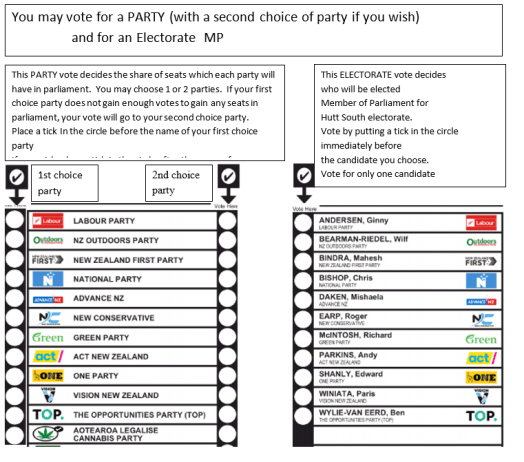
A two choice party voting paper might look like this (note itś simplicity!)

Keep MMP but help more votes count

There is a very simple way of solving the MMP threshold problem, and it does not require that the threshold percentage be changed or eliminated.

People dislike the threshold (at whatrever level) because it causes wasted votes And the threat of wasted votes is a big problem, and bigger than it looks. People vote less often for small parties. People don t get involved in small parties because votes for a minor party are votes taken from that party s natural coalition partners.

The 5% threshold is a big problem. Small parties have difficulty getting started. The threat of wasted votes disocurages everyone, including voters, potential small party supporters, people considering forming new parties, the bigger parties who might cooperate with potential support parties.

The threshold means that anybody voting for a minor party has a very real chance that their vote will play no part in deciding which major party will form the next government. What a way to punish new or small parties!

Making the thresholds smaller is not much of a solution. The problem is still there, smaller, but still discouraging. There seems to be a view that a proliferation of small parties in parliament is to be avoided, so abolition is not widely favoured.

Recent articles on Stuff have commented that almost no new parties have gained seats in parliament in 25 years of MMP. A large part of the reason for that is perhaps the way the threshold punishes small parties and anyone associated with them.

There is a simple solution which completely eliminates the problem of wasted votes, which retains the threshold, which helps more people have their vote count, which improves the proportionality of the system, all the while leaving the workings of MMP almost completely unchanged.

Sounds too good to be true, no? All that is needed is to give voters a second choice of party vote. If the first choice party does not make the threshold, the vote goes to the voters second choice, normally for a party the voter thinks is certain to pass the threshold.

Easy to understand. Easy to implement. Easy to vote count and report results fast. Every voter can avoid their vote being wasted. The system is more proportional. Many people supported similar ideas in the 2012 review. Does not advantage left or right. And it is still the MMP that we know and love. But without the bad part.

Below: what the modified voting paper might look like.

More details at http://onthethreshold.nz

Review of electoral law announced

The Government has announced a major review of New Zealand s electoral law. This review will include addressing the problem of the 5% party vote threshold. There is a better solution than just changing the threshold percentage.

The 5% threshold as now implemented distorts voter and party behaviour, because of the fear of wasted votes.

Everybody hates this risk of wasted votes. A vote for a small party risks being wasted and hence playing no part in selecting which party gets to lead the next government. This is of concern to voters, to small parties, and to large parties, as it makes difficulties for all of them. Just changing the level of the threshold does not solve the problem.

Two-choice party voting offers a solution that is very simple and effectively solves the wasted vote problem, while leaving MMP almost unchanged. The only change is that it gives every voter a second choice of party vote . That just requires one extra column on the party voting paper. And one extra tick from the voter, if the voter wants.

If the voters first choice party fails to pass the threshold, then that vote goes to the voters second choice party. The wise voter strategy is to make sure that either first or second choice vote goes to a party certain to pass the threshold. From then on the MMP system works exactly as now.

This very simple change revolutionalises MMP, in a way that should please everyone. Every voter can support a small party if they want, and also be sure of having a vote that counts in the allocation of seats in parliament. Big parties can cooperate better with support parties, because there need be no wasted votes. The threshold percentage can stay the same or be changed.

Here is what the modified voting paper might look like

Consensus for the next step

In order to alleviate the problems with the New Zealand MMP Threshold, a consensus way forward is needed. Two-choice party voting offers that potential consensus. It addresses some of the most important criticisms of the threshold, and makes the voting system much more proportional. And it leaves the threshold percentage unchanged, because there is no consensus on whether or how to change it.

There is a new page on the site, entitled ‘Consensus at last’.