At https://www.democracyproject.org.nz/p/democracy-briefing-politicians-must?utm_source=substack&utm_medium=email Bryce Edward wrote on 19/10.2026 about the problem now facing New Zealand MMP of engineered overhangs.
I posted this comment:
“
There are two related problems with MMP. Vote splitting is appreciated but works in an unconstructive way. Votes for under-threshold parties are discarded, disenfranchising many voters. Vote splitting invites a false separation of candidates from their allied parties.
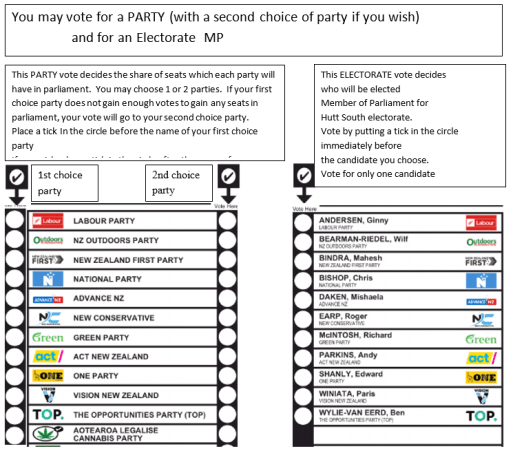
These two problems appear to have a simple combined fix that resolves both issues. We need to alter vote splitting so that every voter gets a say in the allocation of seats amongst threshold passing parties, and also so that voters cannot both vote for a winning local candidate and have a party vote for a different party.
This change does not even need a change in the voting paper layout, just a change in the instructions and vote counting.
1. The electorate vote becomes the “main vote”, a vote for a party and (if one exists)its local candidate.
2. The party vote becomes a “substitute party vote”. This becomes the voter’s party vote in the event that the main vote party does not pass the threshold and the main vote candidate is not elected as the local MP.
These minor changes transform the way MMP works. They effectively prevent any voter getting two effective votes as is now possible. It also removes the wasted votes problem. If a voter’s main vote neither elects the local MP nor gives a party vote to a threshold-passing party, the the substitute party vote comes into play. This has the same constraints as the existing party vote: if you want your substitute party vote to count, you need to vote for a party that passes the threshold. No more wasted votes.
This change does not completely eliminate overhangs, but it makes them difficult to create artificially. The TPM issue is worth looking at here. The need to vote both for the party and its candidate makes overhangs rare but not impossible.
This is still vote splitting, but fixed so that it works usefully. If you vote for a candidate, it means that you want that candidate’s party in parliament or that candidate as an independent local MP. If neither of those happen, you get a substitute party vote which you can give to a party you are sure will pass the threshold.
These simple changes look like they fix the major problems of MMP. You no longer have the wasted votes people so detest, nor the need to vote strategically. Artificial overhangs become effectively impossible. And the result is extremely party proportional.
“
Where did this idea come from?
The idea of offering MMP voters a second choice of party vote has been around for many years in Germany and in New Zealand. This website focusses on this idea. The second choice of party vote has the effect of allowing each voter to both vote for their preferred party, and if this does not pass threshold, then to have a substitute party vote to vote for a party the voter deems certain enough to pass the threshold. This removes the problem of wasted votes and allows new parties to grow without harming allied but larger parties. The second choice of party vote has various names including spare vote, substitute vote.
The problem of engineered overhangs has been apparent for many years, It was a minor issue, but one that seems now to be seen as a strategic option. It is something that could be exploited in a way very detrimental to the MMP system.
A way to reduce, but not always ellininate, overhangs is to invite only one vote from each voter, this vote being for a party and its candidate. This makes impossible engineered overhangs through vote splitting, but it takes away the vote splitting that people like, even if many do not understand how it works.
I recently realised that these two ideas could be combined. One requires one less party vote column on the voting paper, the other an additional such column. Then came a realisation that both changes could be effected without adding or removing voting paper columns. All that is needed is updated instructions and vote counting methods.
The result is the proposal described above. It keeps vote splitting, but changes how that functions. Voters vote first for a party and its candidate (if there is a local candidate). In case their chosen party does not pass threshold and their chosen candidate does not get elected as local MP, then they can express a s ubstitute party vote to apply in such situations.