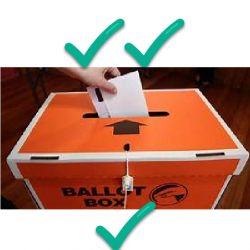
The size of the threshold is not the problem

Here is a comment placed after the following article:

https://www.newsroom.co.nz/smooth-sailing-or-a-windy-road-for-electoral-reform

The problem with the threshold is not so much its size, but the fact that votes, if cast for parties that do not pass one or other treshold, are wasted.

The wasting of votes in this way is widely hated, for well-known reasons.

Reducing but not eliminating the threshold reduces but does not eliminaate this vote wasting effect.

Reducing or eliminating the threshold prejudices the avowed purpose of the threshold – to discourage the proliferation of small parties in parliament.

The solution is one easily understood and widely used in many situations where we want people to make choices, and we want to ensure that almost nobody misses out. That solution is to offer each voter a second choice of party vote.

No need for a complex preferential voting system. Just a second choice eliminates the problems. Voters can vote first choice for their preferrred party, and second choice for a party which they think is certain to pass the threshold. If their first choice does not pass one or other threshold, their vote goes to their second choice.

This is easy to understand, easy to implement, and solves the problem.

More details at twochoicemmp.wordpress.com

More on History of MMP election results

Thank you for the comment suggesting that wasted votes might be compared the level of non-voting and informal votes.

Each of these statistics tells us something a little different.

Turnout (the inverse of non-voting) shows the level of engagement in the population. MMP elections have had turnout percentages between 74% and 88%, with the highest figure for the first such election. I’d interpret that high figure as indicating a high level of support for the new system.

The level of informal votes indicates, I understand, voters who wanted to make a protest of some kind, or who did not fill out the voting paper properly. For MMP elections that rate of informal votes ranged between 0.39% and 0.95%. The lowest figure was for the first MMP election. That suggests that voters did not have difficulty adapting the new voting paper. For later elections voters were less careful or more often wanted to make a protest.

I do not fully understand how spoiling a voting paper can be seen as a useful form of protest, but I understand that it is not uncommon.

Wasted votes for failing to meet a threshold fall into another category, one which is more directly associated with design of the voting system. These voters have gone to the trouble of voting. they had no way of knowing whether their preferred party would meet the treshold, but still their vote was disregarded. If the aim of a proportional voting system is to measure numbers of voters supporting different parties in government, then it is important that voters be able to support a party that may not pass the threshold AND have a say in the makeup of parliament.

Often, I’d suggest, people supporting minor parties are those with a strong interest in the political process, and perhaps in supporting new ideas. The threshold system without a second choice forces those people to either put aside their support for a small party OR risk taking no part in the deciding the makeup of parliament.

That is a difficult choice for someone with a strong interest in the political process.

Reducing the threshold only reduces the problem, it does not eliminate it, whereas the second choice eliminates the problem.

Here are the turnout and informal vote stats, transcribed from the election results website.

ElectionTurnout %Informal %
202082.240.73
201779.750.41
201477.900.45
201174.210.88
200879.460.51
200580.920.46
200276.980.42
199984.770.95
199688.280.39
Turnnout and informal vote stats for MMP elections. Manually transcribed from results site.

Small aside. We are very fortunate in New Zealand to have such easy access to stats like this. Reseaching other countries, it is often very difficult to find similar information.