Have we been barking up the wrong tree?

New Zealand seems to have been barking up the wrong tree for much of the last 25 years looking for a solution to the MMP threshold problem.  No good solution has been identified, and MMP review recommendations remain unimplemented.  

But there is a very simple, easy to understand solution that keeps the threshold but eliminates the problems.

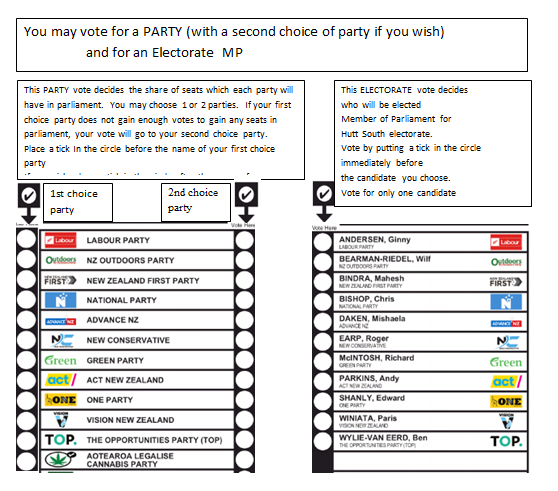
Give voters a second choice of party vote.  If a voter’s first choice party does not pass either threshold, their vote goes to their second choice party.    Voters are advised to make one of their  choices for a party that is certain to pass one of the thresholds.  Nothing else changes.

This solution is easy to understand, easy to implement, and does away with the problems.

Many, perhaps most, voters know which major party they want to see lead the next government.   Many also want to support a small party, but cannot know whether that small party will pass a threshold for gaining seats in parliament.  If they do not vote for the small party, nobody ever knows they supported it.  If they do vote for a small party that misses the threshold, they have no say in government formation.  Many voters struggle with this choice every election.

The second-choice system allows voters to clearly state the party they want to see represent them in parliament, but also have a say in government formation if their preferred party does not pass a threshold

The second choice of party vote requires a second column on the party vote part of the voting paper.  Once it is clear which parties will pass a threshold, each polling place can prepare its own results table.  Results for any grouping of polling places, electorate, region, island, national, specials, overseas, etc are easily obtained by simply adding up the results from the polling places involved.

Ideas like this were suggested by numerous submitters to the 2012 MMP review, and a few described a system in detail.  The proposal here is a little different in that it simplifies the allocation of second choices.  The message is to choose who you like,  for the first choice.  If you think this party might not pass the threshold, make a second choice for a party that will pass.

The second choice has the same limitations as the present vote.  The vote only counts if it is for a threshold passing party.

This change  takes away all the problems with the existing threshold.  People can express support for a small party, and play a part in deciding the next government.

Nobody needs to worry that votes for small parties may be wasted.  Even if a small party does not pass a threshold, its true level of support is publicly known, and its supporters still have a say in government formation.

This change considerably clears the air for everybody with an interest in the election.  Big parties get to keep the threshold they believe is important.  No votes need to be wasted.  Small parties are still excluded from being allocated seats in parliament, but their votes are recorded and their voters still have a say through their second choice.  The big problem of a party just missing the threshold and so changing the lead party in government is gone.  The system presents a much lower barrier to entry to small parties, while still preventing a proliferation of small parties in parliament.

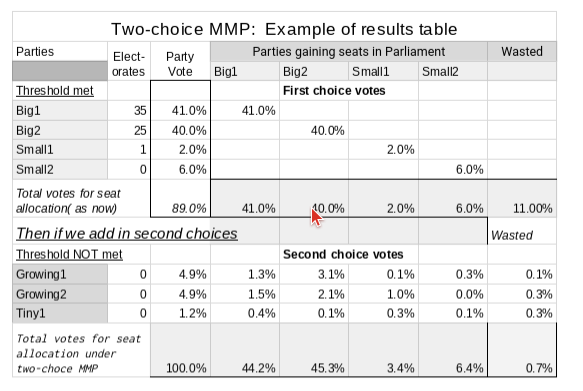
The example results table shows a hypothetical situation where two small parties just miss the 5% threshold.  With the two-choice system, voters for those small parties have their second choices counted instead.
The size of the threshold is not the problem

Here is a comment placed after the following article:

https://www.newsroom.co.nz/smooth-sailing-or-a-windy-road-for-electoral-reform

The problem with the threshold is not so much its size, but the fact that votes, if cast for parties that do not pass one or other treshold, are wasted.

The wasting of votes in this way is widely hated, for well-known reasons.

Reducing but not eliminating the threshold reduces but does not eliminaate this vote wasting effect.

Reducing or eliminating the threshold prejudices the avowed purpose of the threshold – to discourage the proliferation of small parties in parliament.

The solution is one easily understood and widely used in many situations where we want people to make choices, and we want to ensure that almost nobody misses out. That solution is to offer each voter a second choice of party vote.

No need for a complex preferential voting system. Just a second choice eliminates the problems. Voters can vote first choice for their preferrred party, and second choice for a party which they think is certain to pass the threshold. If their first choice does not pass one or other threshold, their vote goes to their second choice.

This is easy to understand, easy to implement, and solves the problem.

More details at twochoicemmp.wordpress.com

Listening to voters under MMP

When people vote in an MMP election, what is their message?

Some might say:

  • I would like to see (say) the Maori Party in parliament, but I certainly want a left-leaning government. OR
  • I would like to see (say) the TOP Party in parliament, but I certainly want a right-leaning government.

I think that many people in NZ see elections in this way. But they cannot vote accordingly.

Unfortunately with the present MMP system, you can only say one of:

  • I’d like to see (say) the Maori Party in parliament, but I’m worried they may not pass the threshold and then my vote would be wasted, so I will vote Labour because I want a left- leaning government.
  • I’d like to see (say) the TOP Party in parliament, but I’m worried they may not pass the threshold and then my vote would be wasted, so I will vote National because I want a right-leaning government.
  • I’d like to see (say) the TOP Party in parliament, but if they miss the threshold, I have no further interest in the result of the election.
  • I’d like to see (say) the Maori Party in parliament, but if they miss the threshold, I have no further interest in the result of the election.

I think many people choose one of the first two. Getting a government that leans their way is more important than supporting their preferred party.

There are relatively few that have no further interest in the result if their preferred party does not reach the threshold.

I think that many people are not happy with this. They would prefer to be able to express both their support for a preferred party, AND to have a say in which way the elected government leans.

The two-choice party vote system allows voters to express what are common views:

I want to support a smaller party. But if that party does not pass the threshold, I do not want my vote wasted. I want my vote instead to go this other party.

And what is perhaps surprising: this is very easy to do. An extra column on the party voting paper is all that needs to be visible to the voter. The voter can place a tick in that column, if they want to. Vote counting is fractionally more complicated.

But now we have available the options that (I say) most people want.

An analogy for party votes: seating at a Wedding Breakfast

Imagine receiving a wedding invitation, that says:

We would like to seat you at a table with good company. So please say which table you would like to sit at for the Wedding Breakfast

We will have a few larger tables, including one for his family and family friends, one for her family and family friends.

There may be some smaller tables, for special groups. Possibly a table for her work friends, one for his work friends, one for people from their gym, and one for their cycling friends. But we will only have each of those smaller tables if there are enough people wanting to sit there.

If you choose one of the smaller tables, but there are not enough people to fill it, we won’t have a table for that group at all and we will cancel your invite.

Whoa you say, that is not very friendly.

It would be more friendly and normal to say:

If you choose one of the smaller tables, but there are not enough people to fill it, we will place you at one of the larger tables. Please say which you would prefer, with his family or her family.

That demonstrates the difference between the present and proposed MMP systems. If you can’t give someone what they would prefer, do not reject them entirely, as at present. it is better to offer them a second choice.

More on History of MMP election results

Thank you for the comment suggesting that wasted votes might be compared the level of non-voting and informal votes.

Each of these statistics tells us something a little different.

Turnout (the inverse of non-voting) shows the level of engagement in the population. MMP elections have had turnout percentages between 74% and 88%, with the highest figure for the first such election. I’d interpret that high figure as indicating a high level of support for the new system.

The level of informal votes indicates, I understand, voters who wanted to make a protest of some kind, or who did not fill out the voting paper properly. For MMP elections that rate of informal votes ranged between 0.39% and 0.95%. The lowest figure was for the first MMP election. That suggests that voters did not have difficulty adapting the new voting paper. For later elections voters were less careful or more often wanted to make a protest.

I do not fully understand how spoiling a voting paper can be seen as a useful form of protest, but I understand that it is not uncommon.

Wasted votes for failing to meet a threshold fall into another category, one which is more directly associated with design of the voting system. These voters have gone to the trouble of voting. they had no way of knowing whether their preferred party would meet the treshold, but still their vote was disregarded. If the aim of a proportional voting system is to measure numbers of voters supporting different parties in government, then it is important that voters be able to support a party that may not pass the threshold AND have a say in the makeup of parliament.

Often, I’d suggest, people supporting minor parties are those with a strong interest in the political process, and perhaps in supporting new ideas. The threshold system without a second choice forces those people to either put aside their support for a small party OR risk taking no part in the deciding the makeup of parliament.

That is a difficult choice for someone with a strong interest in the political process.

Reducing the threshold only reduces the problem, it does not eliminate it, whereas the second choice eliminates the problem.

Here are the turnout and informal vote stats, transcribed from the election results website.

ElectionTurnout %Informal %
202082.240.73
201779.750.41
201477.900.45
201174.210.88
200879.460.51
200580.920.46
200276.980.42
199984.770.95
199688.280.39
Turnnout and informal vote stats for MMP elections. Manually transcribed from results site.

Small aside. We are very fortunate in New Zealand to have such easy access to stats like this. Reseaching other countries, it is often very difficult to find similar information.

History of MMP results

I have created a report to show the party vote results for all nine MMP elections up to 2020, using a consistent format. The information comes from the official site electionresults.org.nz where the results of each election are provided but in various different formats. It provides for each party at each MMP election the number of party votes they received, the number of electorates won. My report shows which parties passed one or other of the thresholds (electorate seat won, at least 5% of party votes), and thus how many votes were wasted because parties did not pass either threshold.

The report can be seen here mmphistoryreport.pdf I believe that I have interpreted and transferred the data correctly.

From the report one can see:

  • That the wasted votes vary between 1.3% (2005) and 7.8%(2020), with an average of 5.4%.
  • The rate of wasted votes is very variable. It was very low in 2005 when there were many minor parties in parliament, many having won just one electorate seat. It was high in 2020, small parties having benefitted from a reduced National Party vote, without crossing a threshold.
  • The 2008 election would have been extremeely close between left and right leaning parties, had the threshold been 4% instead of 5%.
  • The larger numbers of wasted votes have generally been associated with a party gaining about 4% of the party vote, and thus having its votes wasted.
  • This suggests that the two choice system could reduce wasted votes from the present 5% to less than 1%. This is useful, but the main value of the two choice system is to reduce the risk of wasted votes, which is commonly seen as a real obstacle to voting for or working with small parties.

Labour-Greens agree to consider electoral reforms

An item on stuff.co.nz on 31/10/2020 says that the Labour-Greens Cooperation agreement contemplates electoral reform, including the recommendations of the 2012 review of the MMP system.

That report proposed lowering the existing 5% threshold but that change does not seem to have universal support. Two-choice MMP may be a solution that is a good compromise. It allows the threshold to remain while ensuring that people supporting parties that do not pass the threshold can still have a say in the makeup of parliament.

This would remove the ‘threshold anxiety’ that arises every election:

  • Voters are reluctant to vote for small parties for fear their vote may be wasted in deciding the next government.
  • Major parties fear that their likely support parties may miss the threshold, so denying them the chance to form a government.
  • Minor parties fear that they may just rob votes from the major party they might hope to form a coalition with.
  • The country may encounter a cliff face after an election. One party very close to 5%. Whether a party receives 4.9999% or 5.0000% can change the government. Deciding that could prompt a constitutional crisis, as every last detail of voting and vote counting is debated.

Here’s a post from just after the 2008 election

A post from another site from November 2008.  An example of where the threshold had the effect of moving the result towards the right, by having 7% of votes wasted.  Read it here  :

The final results of the 2008 New Zealand general election were announced in the last few days.  Analysis of the results shows some interesting things:

  • The last seat was a very close run thing between Labour and National.  About 40 more votes for Labour would have given Labour one more seat and National one less.
  • The threshold had the effect of rendering useless the 4% of list votes given to NZ First.
  • Another 3% of votes had no effect on the makeup of Parliament.
  • Had the threshold been 4%, NZ First would have won 5 seats.  A Labour-led government wouls have been possible, although it would have required all parties except Nat and Act to support it.  The hypothetical results table below, calculated according to official method apart from threshold setting.

Election result had 4% threshold applied to this election

I’d like to see the rules changed to avoid votes being wasted like this.  Two ideas:

  • Exclude the top 4-6 parties from the threshold.
  • Allow voters to nominate another party to get their list vote in the event of the threshold not being  passed.

Will Gareth Morgan’s TOP party make the threshold?

On Stuff (stuff.co.nz) 1 July 2017 there was an item about TOP party created by Gareth Morgan.

A major theme of the article is that this party may not make the 5% threshold for gaining seats in Parliament.  If the party does not make the threshold, the effect will be to take votes away from other parties.

The difference between making the threshold or not could decide the government.  We have already had parties from right and left gain more than 4% of the party vote, but fail to pass the 5% threshold.  So far these situations have not had a huge effect.

But imagine a situation where one party (or grouping) (‘group A’) receives 48% of the vote, another (‘group B’) 47%, and a small party (‘Party C’) 5%.  But did that small party receive 4.99% or 5.00001%.

Under present rules, the answer to that question (insignificant as it may seem), can change the government.    If it was 4.99% or less for party C, group A can form a government with a 48% to 47% majority. If party C made 5.00001%, it can join with group B to form a government with a 52% to 48% majority.

This situation, eminently possible,  would have all sorts of undesirable effects:

  • There might need to be detailed analysis of every vote that might have been for party C, to ensure that it really was valid or invalid.
  • If there is any kind of problem with votes having been lost, or people not having been able to vote, then the result would hang in the balance until the situation was resolved.
  • Supporters of party C and group B would rightly feel aggrieved that an arbitrary threshold denied them the chance of forming a government.
  • Supporters of small parties would be even more reluctant to support them.

And just the possibility of this kind of result puts many people off voting for small parties.    And that defeats much of the purpose of MMP.   That is that small parties be able to grow, and when they have adequate support have representation in Parliament.

A solution to this was proposed by at least three submitters to the 2012 MMP review.  The solution seems, unfortunately, not to have been seriously considered.  It was mentioned briefly in the final report, hidden away under a heading related to different ways of selecting electorate MPs.

These submitters suggested that voters be given a second choice of party.  There would be two column on the party voting form, one for first choice party, and one for second choice.    Votes with a first choice of a party that fails to make threshold, would instead be given to the second choice party.

Most people voting for a party at risk, would give their second choice to a larger party more likely to make the threshold.

Thus the vast majority of votes would count in the final proportionality of Parliament.

Under the present system 10 to 15% of votes can be wasted.  Under the proposed two choice system, this percentage could drop almost to zero.

More information will be going up on this site in coming days and weeks.