Beware of organised overhangs

MMP aims to allocate seats in parliament in proportional to voter support for political parties. Two-choice voting can remove most of the distortions that arise from the use of party-vote thresholds. But should an indpendent win an electorate seat, or a party win more electorate seats than its party votes justify, then an <overhang> is created. This, in the NZ system, is addressed by creating extra seats. The Maori Party has won overhang seats a few times.

But this system seems to invite manipulation, by electing independents who are not really so. A party would encourage candidates in safe seats to become independent <friends of the party>. The home party would not stand a candidate against them. These <friends> would be expected to win their electorate seats, and create an overhang.

A similar idea has already been used in Epsom, where ACT has been able to win the electorate seat, while National benefitted from the party vote. In this case, I think the move helped ACT pass the one-seat threshold for being allocated seats.

This idea might be acceptable in isolated cases, but imagine if major parties has a dozen of these arrangements each. The result could be 20-seat overhangs.

One might hope that the voters would reject such moves as unfair, and punish those practising it. Or it could become an accepted political manoeuvre.

I think that the current electoral system review should ensure that the rules make such manoeuvres more difficult. But this does not seem easily achieved.

One method would be to require, instead of votes for person and party separately, a single vote for a person and their party. Thus a vote for a Blue party candidate would also be a party vote for the Blue Party. Two-choice party voting would work well with such a system, except that the first choice would be for person and first choice party, the second for a second choice party.

See here for a Stuff article that mentions this issue.

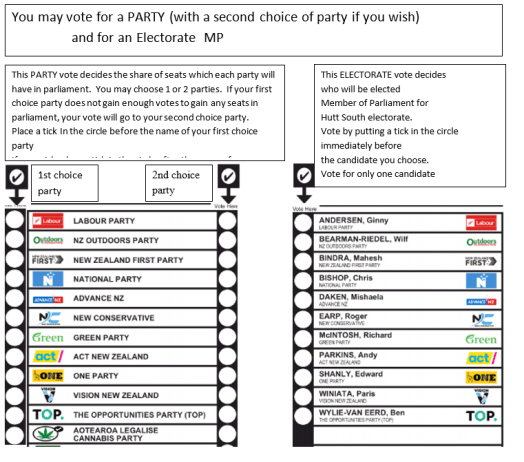
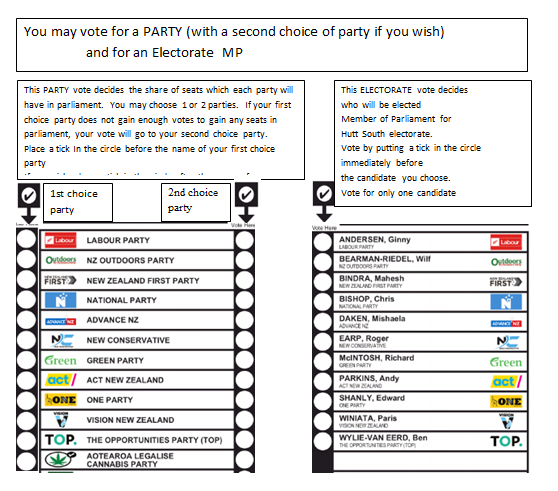
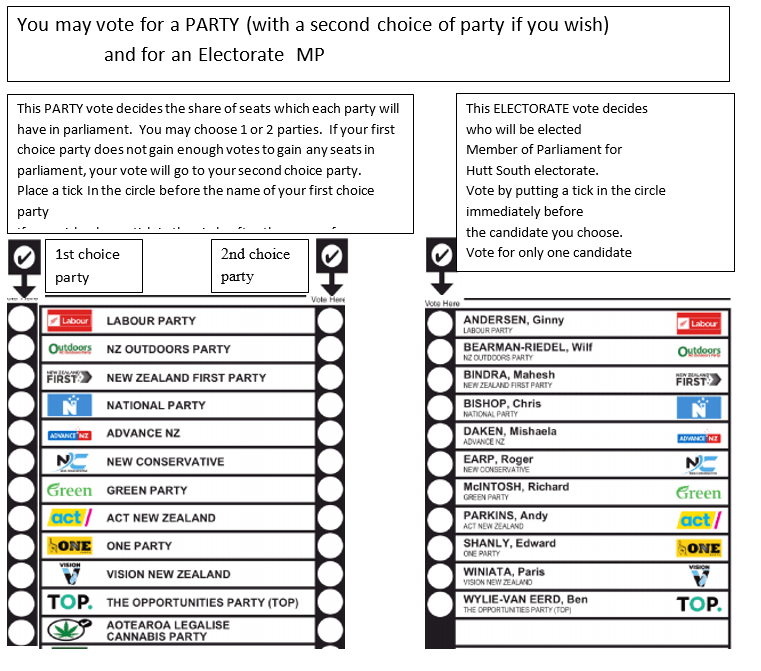
A two-choice MMP voting paper might look like this:

A two-choice MMP voting paper might look like this

A second choice: like Supplementary vote for PR?

Supplementary vote is a voting system for selecting one person. Each voter may make a first and second choice (no more!). The top two candidates, on first choice votes, are retained. Where a voter voted for a candidate other than the top two, their second choice vote is applied, if it is for one of the top two candidates. This system is used for Mayoral races in the UK. SV is viewed as encouraging a more positive style of campaigning as candidates desire the second preferences of third parties.

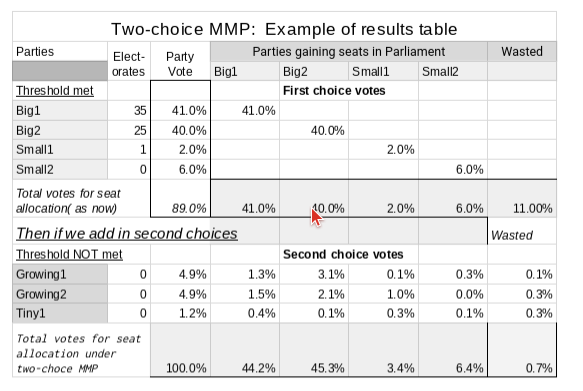
Two-choice party voting has some similarities, except that it is used to measure voter support for parties under MMP. Parties passing a set threshold, on first choice votes, continue to the next stage, where they receive the second choice votes from voters whose first choice party did not pass the threshold.

Both of these systems are based on the idea that first and second choices are often clear in the voters minds. Using lower level preferences is less useful and makes complex many aspects of voting and vote counting.

These systems are simple, but get most of the benefits offfering preferences, while avoiding the complexity of multi-level preferences. Two-choice party voting means every voter can both vote for whichever party they wish, and have a say in the allocation of seats in parliament.

A two choice party voting paper might look like this (note itś simplicity!)

Keep MMP but help more votes count

There is a very simple way of solving the MMP threshold problem, and it does not require that the threshold percentage be changed or eliminated.

People dislike the threshold (at whatrever level) because it causes wasted votes And the threat of wasted votes is a big problem, and bigger than it looks. People vote less often for small parties. People don t get involved in small parties because votes for a minor party are votes taken from that party s natural coalition partners.

The 5% threshold is a big problem. Small parties have difficulty getting started. The threat of wasted votes disocurages everyone, including voters, potential small party supporters, people considering forming new parties, the bigger parties who might cooperate with potential support parties.

The threshold means that anybody voting for a minor party has a very real chance that their vote will play no part in deciding which major party will form the next government. What a way to punish new or small parties!

Making the thresholds smaller is not much of a solution. The problem is still there, smaller, but still discouraging. There seems to be a view that a proliferation of small parties in parliament is to be avoided, so abolition is not widely favoured.

Recent articles on Stuff have commented that almost no new parties have gained seats in parliament in 25 years of MMP. A large part of the reason for that is perhaps the way the threshold punishes small parties and anyone associated with them.

There is a simple solution which completely eliminates the problem of wasted votes, which retains the threshold, which helps more people have their vote count, which improves the proportionality of the system, all the while leaving the workings of MMP almost completely unchanged.

Sounds too good to be true, no? All that is needed is to give voters a second choice of party vote. If the first choice party does not make the threshold, the vote goes to the voters second choice, normally for a party the voter thinks is certain to pass the threshold.

Easy to understand. Easy to implement. Easy to vote count and report results fast. Every voter can avoid their vote being wasted. The system is more proportional. Many people supported similar ideas in the 2012 review. Does not advantage left or right. And it is still the MMP that we know and love. But without the bad part.

Below: what the modified voting paper might look like.

More details at http://onthethreshold.nz

Review of electoral law announced

The Government has announced a major review of New Zealand s electoral law. This review will include addressing the problem of the 5% party vote threshold. There is a better solution than just changing the threshold percentage.

The 5% threshold as now implemented distorts voter and party behaviour, because of the fear of wasted votes.

Everybody hates this risk of wasted votes. A vote for a small party risks being wasted and hence playing no part in selecting which party gets to lead the next government. This is of concern to voters, to small parties, and to large parties, as it makes difficulties for all of them. Just changing the level of the threshold does not solve the problem.

Two-choice party voting offers a solution that is very simple and effectively solves the wasted vote problem, while leaving MMP almost unchanged. The only change is that it gives every voter a second choice of party vote . That just requires one extra column on the party voting paper. And one extra tick from the voter, if the voter wants.

If the voters first choice party fails to pass the threshold, then that vote goes to the voters second choice party. The wise voter strategy is to make sure that either first or second choice vote goes to a party certain to pass the threshold. From then on the MMP system works exactly as now.

This very simple change revolutionalises MMP, in a way that should please everyone. Every voter can support a small party if they want, and also be sure of having a vote that counts in the allocation of seats in parliament. Big parties can cooperate better with support parties, because there need be no wasted votes. The threshold percentage can stay the same or be changed.

Here is what the modified voting paper might look like

Scottish MMP/AMS elections 6 May 2021

I am writing this late morning on 7 May 2021 in France. There was an MMP/AMS election yesterday in Scotland. And there are no results yet, it seems!

We are fortunate in New Zealand, that General Election results are processed quickly, and we seldom if ever need to go to bed on election night without having a very good idea of the result.

The Scottish system is very similar to the New Zealand one, but is called AMS, for A-additional M-member S-system. Named because they (like NZ) elect constituency MPs then ‘add’ list members to create a proportional result.

**********Edit 23/10/2022: The Scottish AMS system does not in fact produce a proortional result. There are normally overhangs in Scotland because the SNP is very dominant. And Scotland uses a ‘ modified d’ Hondt system’ to allocate seats. This seems to be cunningly designed to take list seats from small parties to make seats for SNP overhangs. In the process the result moves significantly away from proportionality. And they say they do not have overhangs.*******************

The Scottish system differs in that Scotland selects list MPs in eight regions, so that each region has it own more or less proportional result. There are no fixed thresholds, but because each region elects only about 16 MPs, there is an effective threshold of about 8%. Scotland also uses the d’ Hondt method for allocating seats, whidh reputedly is more favourable to larger parties that the StLague system in NZ.

It seems a problem of many description of MMP/AMS that they talk about having constituency elections then about ‘added’ list MPs to achieve proportionality.(***See edit above*****)

But as we know, it is the party votes that determine in MMP/AMS the overall makeup of parliament. So it is simpler to say that we use party votes to determine the overall number of seats in parliament for each party, and THEN fill those seats beginning with electorate/constituency winners, and taking the rest from party lists. (Noting that Scotland uses open party lists so that voters have a choice of list members, but voting papers are more complex).

Once you see it this way, the party votes are what you count first, because they take you straight to the overall result. By contrast the constituency and list results are of mainly local interest.

Two conclusions:
1. Descriptions of AMS/MMP should make more clear that it is party votes that almost solely determine the numbers seats in parliament for each party.
2. Once this is understood, it seems that Scotland could determine much more quickly the overall result of its AMS elections.

Comments relating to the New Zealand MMP threshold:

The use of several regions in Scotland makes for quite high effective thresholds. Many tiny parties have no hope of representation. The system might be made more proportional by having a fixed threshold and offering a second choice of party vote. That would allow every voter to vote for a party representated in parliament. The use of open lists in Scotland makes voting papers, and hence a second choice of party vote, more complicated than is proposed for NZ.

Is there a flaw in the NZ MMP electoral system?

It seems that there is a problem with many implementations of MMP and similar electoral systems.  The problem stems from the use of thresholds to avoid a proliferation of small parties in the representative assembly.

Having a threshold seems innocuous enough, assuming one accepts the premise that it is desirable/important/useful/acceptable to limit the representation of very small parties in parliament.  

It seems that most thresholds are implemented in a very simplistic way.  If a party does not pass the threshold, it is completely excluded from the assembly.   Its votes are discarded.  It has no right to have any paid representatives present, to receive any secretarial or office space support, to speak, or to vote.  

After discarding the votes of under-threshold parties, seats are  allocated generally in proportion to the remaining, qualifying, votes. 

Because of this mode of  operation, the existence of the threshold creates perverse incentives for almost all players.   A vote that was cast for a below-threshold party is a vote taken away from its allied parties and then discarded.   Small emerging parties should be well aware that until they pass the threshold, they are working against their allied parties, and against the chances those allied parties have of forming a coalition government after an election.  Major parties are not immune from these perverse effects.    Major parties need to take into account that apparent support parties, ones of the same side of the left/right divide but below-threshold, are in fact working against the major party’s chances of forming a governing coalition after the election.  So an apparent support party is not something to encourage.  And it is all made more confusing because nobody can be sure in advance which parties will cross the threshold.

So, not only is the threshold something quite high to overcome, but on the way there all parties are disturbed by the perverse effects of a simple threshold.

So the threshold is about much more than the percentage.    It also creates conflicting motivations and loyalties for voters and parties.  Voters are torn between voting for a small party and hence against its allied big party OR  voting for the allied big party and not for their preferred party.    Small parties and their supporters want to encourage voters to support their small party, knowing that they are probably taking votes from the allied big party and wasting them.  Big parties  fear the negative effects of smaller parties that notionally support them.

That explanation was probably confusing.  If so it reflects the confusing and conflicted environment that affects everybody who has connections with small parties in an MMP environment.

But wait there’s more. The MMP party vote does two things.  The first thing is to decide which parties are eligible for seats in parliament.  The second thing is to measure the relative support of each, and to allocate seats in parliament accordingly.  But the voters who voted for under-threshold parties have no say in this allocation.  If we are aiming to measure relative support, it seems unfortunate to leave out up to 8% of voters.

New Zealand’s MMP system uses closed party lists, so the voting paper is very simple.  On this voting paper, adding a second column is easy, to allow each voter a second choice of party vote.  If a voter’s first choice party falls below the threshold, the vote can go to a second choice.  In this way every voter can both nominate a preferred party, and vote for one of the eligible parties.

This second choice eliminates the conflict around small parties and as well allows the party voting to be much more proportional.  And the bonus, for those who think the threshold is important, is that these improvements  can be made without any change to the threshold percentage.

An advantage of this change is that it should help everybody, so perhaps a consensus is achievable without much delay.

There is of course nothing to prevent the threshold being reduced, but that is another question.
More at www.onthethreshold.nz

Consensus for the next step

In order to alleviate the problems with the New Zealand MMP Threshold, a consensus way forward is needed. Two-choice party voting offers that potential consensus. It addresses some of the most important criticisms of the threshold, and makes the voting system much more proportional. And it leaves the threshold percentage unchanged, because there is no consensus on whether or how to change it.

There is a new page on the site, entitled ‘Consensus at last’.

No more wasted votes under MMP

New Zealand has numerous political issues that do not have obvious or easy solutions – housing and covid come to mind.

But there is one problem that can be easily and simply fixed in a way that should please just about everyone.  That problem is the MMP threshold and the wasted votes that result.  

Many people want to support a minor party, AND want to influence which major part or parties will get to form a government.  At present they cannot do both.  A vote for a minor party can easily have no effect at all.

The solution comes from realising that the problem  is not so much about the existence or level of the threshold.    The problem is that if you vote for a party that gets neither 5% or an electorate seat,  your vote is wasted.  Nobody likes wasting their vote,  and so the threshold distorts voter behaviour.

The solution comes from applying the same method that we use in many other situations where we want every person to make a choice, and to still get something if their preferred choice is not available.  Yes, you’re onto it.  The solution is to give each voter a second choice.  “Choose the party you prefer, but declare a second choice in case your preferred option is not available”.

Applying this idea to an MMP election is much easier than you might at first think.   First modify the voting paper by adding a second column to the party voting section.    Explain to voters that they can give their first choice to any party.  If they think that this party might not pass one or other of the thresholds, they can make a second choice in the other column.  And if they want to be sure that their vote is not wasted, they make sure that one of their choices is for a party certain to pass a threshold.

At present, perhaps only the two major parties are really safe bets to pass the threshold.  But other parties are becoming established.  But each voter is free to choose who to vote for.

The voting paper can be very fault tolerant.  As long as one or other column has just one tick, the intention is clear.  The other column will normally show the other choice, but can be blank or with multiple ticks or whatever.

Vote counting is just a little more complex.  Usually it becomes clear early on which parties have passed the threshold.   Each polling place can prepare its own result table.  Results tables by electorate, region, etc are easily created by grouping the results as required.

From this point on the allocation of seats in parliament proceeds exactly as now.

What would be the result  of this modest change to MMP elections?  All the anxiety about vote-wasting is gone.  Every voter can both choose their preferred party, and be sure that whatever happens they can have a vote that counts.  The result is that much more proportional.

There is no problem if either threshold is abolished or changed. If all the thresholds were to be abolished there’d be no need for the second choice.

You can read about this idea at www.twochoicemmp.wordpress.com.

Another recent article describing this idea can be found at

If only other political problems were as easy to solve as this one.

This solution removes the serious wasted-votes problem that distorts voter behaviour and is often complained about, while retaining the 5% threshold that the major parties seem to place importance on. I am hopeful that it might be a practical, minor and importantly widely acceptable solution.

Below how the

Even more essential

A New Zealand MMP election does two things:

  1. It decides which parties will be eligible to be allocated seats in parliament.
  2. It allocates those seats in parliament in proportion to (eligible) voter support.
    BUT
    Only people who voted for a winning party in step 1 may take part in step 2.

I think that every voter should have a say at step 2.

Two choice party voting does that, without the need to change the threshold percentage or any other aspect of the MMP system.

The 2020 Hutt South voting paper with a second choice column added

What is the essential issue here?

The essential issue: The big problem with the MMP threshold is the wasted votes that result. Giving voters a second choice of party vote can virtually eliminate wasted votes, and does not require any change to the threshold.

Yes, the 5% threshold is a very high one.  But it is made much more difficult to overcome by the wasted votes that go with the present threshold.

The risk of wasted votes distorts the behaviour of voters, of small parties, and of larger parties.   Because wasted votes can change the overall result of an election.

The second choice of party vote eliminates the issue of wasted votes, by making it much easier for voters to avoid wasting their votes.  A voter may vote for a small party, but if this party misses the threshold, the voter’s second choice can count.

The present parliamentary inquiry into the 2020 election should consider how to eliminate this serious problem of wasted votes.  Two-choice party voting would do it simply and easily.

The size of the threshold, and whether the electorate seat threshold should be retained, are separate issues.